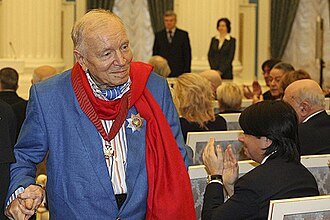
Andrei Voznesensky (Moscow, 1933 - Moscow, 2010) was one of the best-known poets of the Soviet Union and later of Russia. He wrote in Russian, and his name is tied to the generation that came to prominence during the Khrushchev Thaw, the brief period of greater cultural openness after Stalin's death. His lasting significance lies in bringing a modern sensibility to Soviet poetry: bold images and carefully worked sound, set against the socialist realism that had dominated earlier decades.
Voznesensky trained first as an architect. He studied at the Moscow Architectural Institute and graduated in 1957, though poetry eventually won out over the profession. As a teenager he had sent his verses to Boris Pasternak, who became a mentor and a close presence in his life, and their friendship shaped his view of literature. His first poems appeared in 1958 and were recognised at once for a distinctive manner: a habit of measuring the modern person against contemporary categories and images, unusual metaphors, complex rhythms and deliberate sound effects. Vladimir Mayakovsky and Pablo Neruda are usually cited among his main influences.
During the 1960s his fame grew to a scale rare for a poet. He read to audiences of thousands in stadiums, concert halls and universities, and his delivery was widely admired. He travelled abroad often, and on those trips he came to be seen as something like an unofficial cultural envoy. The popularity brought friction too: his daring style drew steady criticism from fellow writers, and Nikita Khrushchev once threatened him with expulsion, though on another occasion the same leader publicly mocked him.
His work moved between lyric poetry and formal experiment, and later extended into theatre and music. Some of his poems were staged at the Taganka Theatre, and the rock opera Juno and Avos, based on the love story of Nikolai Rezanov and Concepción Argüello, became one of the first Russian rock operas. He also wrote prose and essays, and kept friendships with writers, artists and intellectuals in many countries.
In his later years he withdrew from public life and suffered health problems, including a stroke. He died in Moscow in June 2010 and was buried at Novodevichy Cemetery. He remains remembered in twentieth-century Russian poetry as a voice that sought to renew poetic language while staying at the centre of the public life of his time. He received the USSR State Prize in 1978, and a minor planet, 3723 Voznesenskij, bears his name.
Key works
- Los maestros (1959), poems.
- The Triangular Pear (1962), one of his most widely read collections, full of unusual images and a finely worked rhythm.
- Antiworlds (1964), a collection that inspired a famous production at the Taganka Theatre.
- Juno and Avos (1972), a long poem on the love of Rezanov and Concepción Argüello, the basis of the rock opera of the same name.
- The Shadow of the Sound (1970), a more reflective collection on voice and language.
Curiosities
A tribute from Pasternak
Pasternak, who died in 1960, paid him a warm tribute, saying he was glad to have lived to see Voznesensky enter literature.
An asteroid named after him
The minor planet 3723 Voznesenskij, discovered in 1976 by the astronomer Nikolai Chernykh, was named after him.
Original Filopedia text based on Wikipedia (es) and Wikipedia (en) and Wikidata.