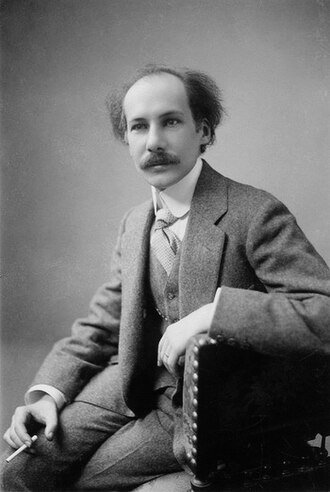
Andrei Bely
1880–1934 · Russian novelist, poet and Symbolist critic
Andrei Bely was the pen name of Boris Nikolayevich Bugaev (Moscow, 1880 – Moscow, 8 January 1934), a Russian novelist, poet and literary critic associated with Symbolism. Vladimir Nabokov counted him among the most important writers in the Russian language, and his novel Petersburg, often compared with Joyce's Ulysses, has become one of the landmarks of modernist fiction.
Bugaev grew up in a prominent intellectual family in Moscow. His father, Nikolai Bugaev, was a respected mathematician regarded as a founder of the Moscow school of mathematics. Between 1899 and 1906 Bugaev studied at Moscow University, first natural sciences and then philology and philosophy, and he took a keen interest in music, religion, Schopenhauer and Nietzsche. He eventually chose to devote himself entirely to literature. He moved in Symbolist circles and, together with Sergei Solovyov, Alexander Blok and Ellis, formed the group known as the Argonauts, which edited the journal The Golden Fleece between 1906 and 1909. His first book, Second Symphony, Dramatic (1902), appeared under the name Andrei Bely so as not to embarrass his father. His four 'symphonies' in poetic prose tried to combine literature, music and painting, and his verse collections pursued the same fusion of the arts.
His first novel, The Silver Dove (1910), and above all Petersburg, serialised between 1913 and 1914, shaped the prose for which he is best known. Petersburg unfolds over roughly twenty-four hours during the unrest of 1905 and follows Nikolai Ableukhov, a young revolutionary ordered to kill his own father, a tsarist senator. The city is the real protagonist, the prose plays with sound and colour, and irony runs through the whole book. Bely revised and shortened it in 1922.
From about 1912 he embraced Rudolf Steiner's anthroposophy and became a personal friend of Steiner. His marriage to Asya Turgeneva took the couple to Dornach in Switzerland. He returned to Russia in 1916 and welcomed the Revolution of 1917, which he treated in essays and in poems such as Christ Is Risen. After the revolution he wrote Kotik Letaev, a psychological novel of childhood, and a new trilogy centred on Moscow, along with memoirs in three volumes. His last book, a study of Gogol's style, appeared in 1934, the year he died.
His works were banned in the Soviet Union from 1940 to 1965. He influenced Yuri Olesha, Boris Pilnyak, Boris Pasternak and Nabokov, and today he is recognised as one of the great renovators of twentieth-century Russian prose.
Key ideas
- Fusion of the arts: his poetic prose aimed to make words sound like music and evoke visual images.
- The city as character: in Petersburg, the capital becomes a space charged with political and mental tensions.
- Anthroposophy: his later thought, shaped by Rudolf Steiner, tried to link Vladimir Solovyov's philosophy with a spiritual view of the world.
- Rhythm and language: his studies of verse and of Gogol's prose show an obsessive attention to the form of language.
Where to start
Petersburg 1913
Petersburg is an urban symbolist novel set in the Russian imperial capital amid political unrest, with richly imagistic prose and an almost musical rhythm. Readers who start here will find an intense, dazzling work, one of the great novels of the twentieth century, though demanding in its formal complexity.
Next: The Silver Dove. The Silver Dove lets you follow his development toward philosophical reflection and the metaphysical concerns that nourish his later work.
Works in Filopedia
- The Silver Dove 1909
- Petersburg 1913
Curiosities
A protective pen name
He published his first book under the name Andrei Bely so as not to embarrass his father, who was dean of the Faculty of Science.
Admired by Nabokov
Vladimir Nabokov held him in high regard and mentioned his study of verse rhythm in his novel The Gift.
Original Filopedia text based on Wikipedia (es) and Wikipedia (en) and Wikidata.