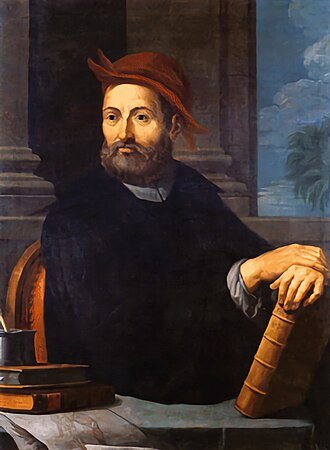
Andrea Cesalpino
1524–1603 · Italian physician, philosopher and botanist of the Renaissance
Andrea Cesalpino was an Italian physician, philosopher and botanist from Arezzo, in Tuscany. His work sits at the meeting point of medicine, Aristotelian philosophy and the emerging science of botany, and he is remembered above all for proposing new principles for organising plants.
According to the sources, he was probably born in the autumn of 1524 or 1525, although some authors give 1519. He studied at the University of Pisa, where Matteo Realdo Colombo taught him medicine and Luca Ghini taught him botany. After finishing his course he taught philosophy, medicine and botany in Pisa for many years, while carrying out botanical explorations in several parts of Italy. Ghini was the first director of the Pisa botanical garden, and Cesalpino succeeded him around 1555.
Later in life he accepted a post in Rome as professor of medicine at La Sapienza and became physician to Pope Clement VIII. For the Jubilee of 1600 he wrote a short history of the Church, which reflects his Catholic orthodoxy.
His most important philosophical work is the Quaestionum peripateticarum libri V (1571), a study of Aristotle written in a often dense style. He is regarded as an Aristotelian shaped by Averroes, and some readers later took his views to edge towards pantheism, which drew criticism from Protestant writers such as Nicolaus Taurellus. Cesalpino himself insisted on his loyalty to Catholic doctrine and said he would reject any Aristotelian claim that contradicted revelation.
In physiology he proposed a "chemical circulation" of the blood, based on its repeated evaporation and condensation. He never reached a full anatomical understanding of the blood's course, but he came closer than anyone before William Harvey to the idea of circulation.
His most important botanical work is De plantis libri XVI (1583), which has no illustrations and rests on close observation of flowers, fruits and seeds. By choosing the reproductive organs as the main criterion, he laid foundations for a scientific classification of flowering plants, and his method later influenced John Ray. He also wrote De metallicis libri tres (1596), which includes observations on minerals and fossils.
He died in Rome in 1603. Linnaeus admired him and cited him often, and the genus Caesalpinia, named in his honour by Plumier, keeps his memory alive in botanical nomenclature today.
Key ideas
- Classification by reproductive organs. He ordered plants by their fruits and seeds, rather than alphabetically or by medicinal uses.
- Chemical circulation. He imagined that blood circulated through repeated evaporation and condensation, an idea that anticipated Harvey's theory.
- Critical Aristotelianism. He studied Aristotle closely, with traces of Averroes, without giving up his Catholic principles.
- Direct observation. He based his botany on careful observation of flowers, fruits and seeds, before the microscope was available.
Curiosities
An early herbarium
In 1563 he arranged a herbarium for Bishop Alfonso Tornabuoni, which is now one of the oldest surviving. It fills three volumes and contains 768 species.
A genus named after him
The Franciscan friar Charles Plumier named a plant genus Caesalpinia, and Linnaeus kept the name in his system.
Linnaeus's tribute
Linnaeus praised him in a Latin verse that gives Cesalpino the first honours in botany.
Teachers and influences
Influenced by
Original Filopedia text based on Wikipedia (es) and Wikipedia (en) and Wikidata.