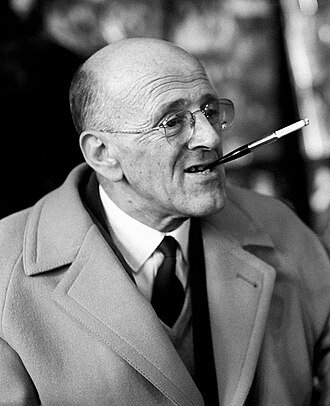
André Chamson
1900–1983 · French archivist, novelist and essayist
André Chamson (Nîmes, 1900 – Paris, 1983) was a French archivist, novelist and essayist who wrote in French with a strong attachment to the Occitan and Cévennes world. His career shows how a trained archive scholar could also become a public literary voice in twentieth-century France.
Trained at the École des chartes, he qualified as an archiviste paléographe in 1924. Before the Second World War he founded and edited the journal Vendredi and worked as a museum curator. In 1937 he attended the Second International Writers' Congress in Valencia, Barcelona and Madrid, where intellectuals debated their stance on the war in Spain. After the war he sat on the editorial board of Europe, curated at the Petit Palais and directed the Archives de France from 1959 to 1971. He led PEN International from 1956 to 1959 and was elected to the Académie Française in 1956.
Most of his fiction is set in the Cévennes, his birthplace. His style is plain and humane, and his themes include solidarity, Protestant life and rural society. During the war he oversaw large parts of the Louvre and helped hide major works, including the Venus de Milo, before joining the armed Resistance. His legacy rests mainly on his Cévennes novels and on his role as a guardian of France's documentary heritage.
Key works
- Roux le bandit (1925), a novel set in the Cévennes.
- Les Hommes de la route (1927), a narrative about the roads and people of the south.
- La Tour de Constance (1970), a novel about the Protestant prison at Aigues-Mortes.
Curiosities
At the 1937 Congress
He attended the Second International Writers' Congress, which was also attended by André Malraux, Ernest Hemingway and Pablo Neruda.
Saving the Venus de Milo
During the war he is credited with helping hide the Venus de Milo in a provincial château.
Original Filopedia text based on Wikipedia (en) and Wikidata.