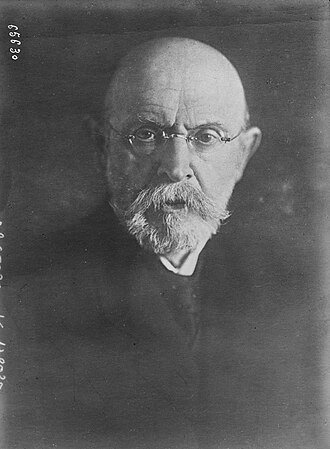
Alois Jirásek (Hronov, 1851 - Prague, 1930) was a Czech writer best known for his historical novels and plays. He lived when Bohemia was part of the Austro-Hungarian Empire, and his work, written in Czech, helped shape a historical memory for a nation that hoped to govern itself. That is why his name still carries weight in Czech literature.
Jirásek came from a modest family of weavers and small farmers. He studied at secondary schools in Broumov and Hradec Králové before reading History at Charles University in Prague. He spent fourteen years teaching in Litomyšl and, after moving to the capital in 1888, went on as a secondary school teacher until he retired in 1909. He married Marie Podhajská in 1879, and the couple raised a large family.
His literary career began with patriotic verse, but he soon turned to prose. His novels about the Hussite period rebuild everyday life in that age with considerable care, though his characters often serve to embody ideals of freedom and justice. He also wrote short stories, legends and plays, and he used many of his journeys to visit the places where his stories are set.
In public life he was close to figures such as Mikoláš Aleš and Josef Václav Sládek, with whom he shared artistic gatherings in Prague. He signed the 1917 manifesto of Czech writers, took part in reading out the declaration of independence in 1918, and after Czechoslovakia was founded he sat in the National Assembly. Some years later he left the Catholic Church, though he continued to regard himself as a Christian.
He died in Prague in 1930 and was buried in Hronov. His legacy rests mainly on how he brought national history to his readers, and modern critics tend to value him more as a chronicler of his time than as a formal innovator. He was nominated for the Nobel Prize in Literature several times.
Key works
- Ancient Bohemian Legends (Staré pověsti české, 1894): a collection of legends running from the mythical origins of the Czech people to the Battle of White Mountain.
- Brotherhood (Bratrstvo, 1900-1909): a three-part novel about the decline of the Hussites after the Battle of Lipany.
- Against Everyone (Proti všem, 1893): a novel about the height of the Hussite movement and the founding of Tábor.
- In Foreign Service (V cizích službách, 1883): a sixteenth-century novel about descendants of the Taborites who became mercenaries.
- Darkness (Temno, 1913-1915): a novel about the religious and political oppression of the Czech nation after 1620, widely read during the First World War.
Where to start
Antiguas leyendas bohemias is a collection of short tales drawing on Czech history, folk tradition and some documented events. It offers an accessible entry point for the curious reader, revealing the legends and foundational myths of Bohemia and showing how Jirásek shaped them into literature tied to the Czech national revival.
Next: Alois Jirásek (author; no work title). To continue, Jirásek's own biography helps place his work in context, showing his life as a writer tied to the national revival and the development of his literary career.
Works in Filopedia
Curiosities
A funeral without bells
After he left the Catholic Church, the institution forbade the ringing of church bells in Prague in his honour. No priest attended his funeral.
A Nobel candidate
He was nominated for the Nobel Prize in Literature in 1918, 1919, 1921 and 1930.
Teachers and influences
Pupils
- Jaroslav Hašek 1883–1923
Original Filopedia text based on Wikipedia (es) and Wikipedia (en) and Wikidata.