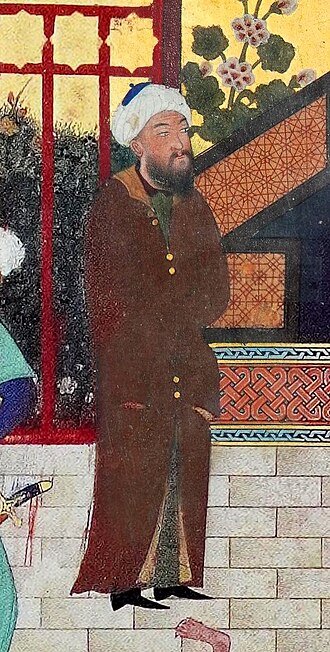
Ali-Shir Nava'i
1441–1501 · Timurid poet, statesman and mystic who wrote in Chagatai Turkic
Mir Ali-Shir Nava'i (Herat, 1441 – Herat, 1501) was a poet, statesman, linguist, mystic and painter from Central Asia, regarded as the greatest representative of Chagatai literature. Working within the Timurid Empire, in one of its most brilliant cultural centres, he is remembered across the Turkic-speaking world as a founder of modern Turkic literature, and many places and institutions in Central Asia bear his name.
He came from a family of the Timurid military and administrative elite. His father served as a senior officer at the court of Shah Rukh Mirza, ruler of Khorasan, and his mother was a governess to a prince. After his father's death he was placed under the guardianship of another regional ruler, and he grew up alongside Husayn Bayqara, who would later become sultan of Khorasan. The family fled Herat in 1447 after Shah Rukh's death and returned once order was restored. Nava'i studied in Mashhad, Herat and Samarkand. When Husayn Bayqara seized power in Herat in 1469, Nava'i joined his service, and he stayed there until his death in 1501, when he was buried in Herat. He is said to have lived an ascetic life and never married.
As adviser and administrator to the sultan, he held real public influence. He is credited with founding, restoring or endowing some three hundred and seventy mosques, madrasas, libraries, hospitals and caravanserais in Khorasan, and in Herat his building activity was so extensive that some historians have compared the city's flowering to a Renaissance. He was also a patron of scholars, poets and musicians.
His literary output was considerable. He wrote mainly in Chagatai under the pen name Nava'i, and also in Persian under the name Fani, and to a lesser degree in Arabic. His four divans contain roughly fifty thousand verses, arranged by the stages of life: childhood, youth, middle age and old age. He also wrote the Khamsa, five epic poems answering Nizami Ganjavi's work, and Lisan al-Tayr, an allegory modelled on Attar's Mantiq al-Tayr in which he sets out his Sufi views. His biographical anthology Majalis al-Nafa'is is still a key source for Timurid culture. His last work, Muhakamat al-Lughatayn, compares Turkic and Persian and argues for the literary superiority of Turkic.
At the core of his thought was the conviction that Chagatai was as rich, precise and flexible as Persian, the prestige language of the court, and deserved to carry high literature. At a time when this view was unusual, it gave him a theoretical foundation and helped Chagatai become an accepted literary language. That legacy explains why he remains a central figure in Uzbekistan and across the Turkic world.
Key ideas
- Superiority of the Turkic language: Nava'i argued that Chagatai could equal or surpass Persian in serious poetry and prose.
- Richness and precision of Turkic vocabulary: he maintained that the mother tongue had enough flexible vocabulary to express nuances usually reserved for Persian.
- Sufism and allegory: in works such as Lisan al-Tayr he presented the soul's journey toward God as a shared search.
- Life in stages: organising his divans by childhood, youth, middle age and old age reflects a view of existence as a spiritual path.
Curiosities
The Chaucer of the Turks
The historian Bernard Lewis called him this, in recognition of his literary stature in the Turkic tradition.
An anthology of nearly five hundred poets
His Majalis al-Nafa'is gathers biographical sketches of about 450 poets and writers, many of them his contemporaries.
Original Filopedia text based on Wikipedia (es) and Wikipedia (en) and Wikidata.