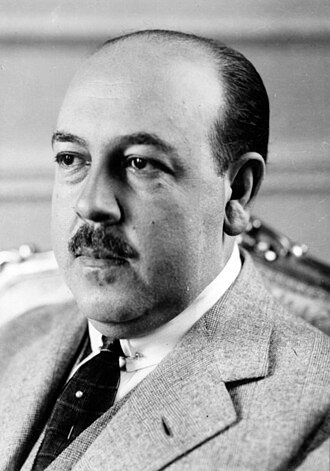
Alfonso Reyes
1889–1959 · Mexican writer, essayist and diplomat
Alfonso Reyes (Monterrey, 1889 - Mexico City, 1959) was a Mexican writer, essayist, philologist, jurist and diplomat, and one of the most important literary figures in the Spanish language in the twentieth century. His work spans poetry, the essay, literary criticism and philology, and belongs to the humanist current that emerged in Mexico at the start of the last century.
The son of General Bernardo Reyes, governor of Nuevo León and a major figure of the Porfiriato, he was educated in Monterrey and Mexico City, where he earned his law degree in 1913. In 1909 he helped found the Ateneo de la Juventud, a circle where he and Pedro Henríquez Ureña, José Vasconcelos and others read the Greek classics and challenged the positivism that had shaped intellectual life under Porfirio Díaz. His first book, Cuestiones estéticas, appeared in 1911. His father's death during the Decena Trágica marked his life, and soon afterwards he entered the diplomatic service and left for Europe.
From 1914 to 1924 he lived in Madrid, a period often seen as the most productive of his career. He worked at the Centro de Estudios Históricos under Ramón Menéndez Pidal, studied the Spanish Golden Age and the poet Góngora, and wrote prose essays such as Visión de Anáhuac, which views the Valley of Mexico through the eyes of the conqueror and blends historical reflection with poetic intuition. His thinking moved between Benedetto Croce's aesthetics and the vitalist philosophy of Bergson, without committing rigidly to any single school.
He served as ambassador to Argentina, Brazil, France and Spain. In 1939 he left the foreign service and returned to Mexico, where he promoted the creation of El Colegio de México, which he presided over from 1940 to 1958. His legacy endures in his complete works, published in twenty-six volumes, and in the admiration of writers such as Jorge Luis Borges, who called him the greatest prose writer in the Spanish language of any age.
Key ideas
- Critique of positivism: the Ateneo de la Juventud championed literature, philosophy and humanism against a scientific and utilitarian outlook that dominated Porfirian culture.
- History as contemporary experience: following Croce, all history is written from the present, so the past is understood through the questions of each age.
- Reading the classics: Greek and Spanish traditions provide the foundation for a critical culture that can engage the past without merely repeating it.
- The essay as a way of thinking: Reyes wrote a personal prose in which erudition, reflection and literary style coexist.
Curiosities
A loaded carbine by the desk
Reyes recalled that, during the years of the Revolution, he wrote in his room in Mexico City with a loaded carbine near his desk, glancing at it now and then and wondering whether he would need to use it.
A tribute on the search engine
On 17 May 2018, Google dedicated a Doodle to him to mark the 129th anniversary of his birth.
Original Filopedia text based on Wikipedia (es) and Wikipedia (en) and Wikidata.