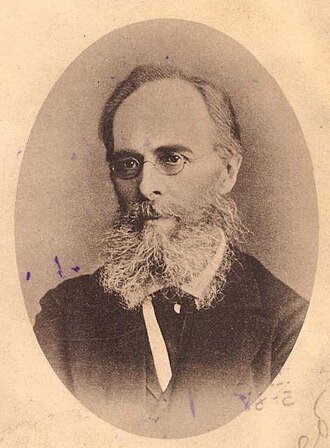
Alexander Potebnja
1835–1891 · Russian-Ukrainian linguist and philosopher of language
Alexander Potebnja (Aleksandr Potebnya in Russian) was a linguist and philosopher of language of Ukrainian Cossack descent, born in 1835 in the Russian Empire and died in 1891. A professor of linguistics at the Imperial University of Kharkiv, he is best remembered for a theory of language and consciousness that later shaped the thinking of the psychologist Lev Vygotsky.
Born into a noble family, he was educated in Radom and at Kharkiv University, from which he graduated in 1856. After a short spell teaching literature at a local school, he defended his master's thesis in 1861 and began lecturing at the university. He took part in folklore expeditions in the Poltava region, travelled abroad in 1862 and attended lectures in Berlin, where he studied Sanskrit, and later earned his doctorate in philology. His major book, Thought and Language (1862), argues that every word has an outer form, a meaning and an inner form, shaped by individual and collective experience and often rooted in myth. That inner form fades over time, and literature can help restore it. His legacy also includes work on historical phonetics, etymology and Slavic syntax.
Key ideas
- Inner form of the word: each term carries collective experience that filters how we perceive the world.
- Language and thought: language is the means by which the mind orders impressions, so one's mother tongue shapes one's view of reality.
- Literature as restoration: the simplest genres, such as the proverb, riddle and fable, directly revive the inner form of words.
- Historical syntax: grammatical categories change with ways of thinking, and traces of older syntax survive in later constructions.
Teachers and influences
Influenced by
- Wilhelm von Humboldt 1767–1835
Original Filopedia text based on Wikipedia (en) and Wikidata.