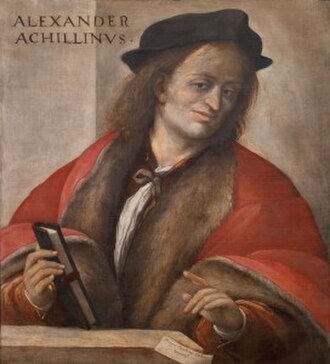
Alessandro Achillini
1463–1512 · Italian philosopher and physician of the Renaissance
Alessandro Achillini (Bologna, 1463-1512) was an Italian philosopher and physician of the Renaissance university world. He matters because he combined the teaching of Aristotle with the hands-on study of the human body, something unusual in his day.
He spent most of his life in Bologna, where he taught medicine and philosophy, with a period at Padua. His students admired him so much that they called him the second Aristotle, though colleagues described him as plain-spoken, somewhat stiff in the lecture hall and formidable in debate. He never married. In 1506 he had to leave Bologna after the fall of the Bentivoglio family, whose cause he had supported.
His writings cover both fields. In philosophy he debated the intellect and universals in works such as Quodlibeta de intelligentiis, and he clashed with Pietro Pomponazzi. In anatomy, taking advantage of permission to dissect human cadavers, he described the malleus and incus of the ear, the bones of the tarsus and the brain ventricles, and set his findings against those of Galen and Avicenna.
His influence passed mainly through his pupils, including Gasparo Contarini and Ludovico Boccadiferro. His Anatomicae annotationes appeared in 1520, after his death.
Key ideas
- Aristotelianism: fidelity to Aristotle's doctrine, which earned him the nickname the second Aristotle.
- Ockhamism: he helped revive interest in William of Ockham at the University of Bologna.
- The intellect: debate over the nature of understanding and universals, with Pomponazzi as his main interlocutor.
- Anatomical observation: testing inherited theories against what dissection reveals.
Curiosities
Seven features instead of six
In his anatomical notes he proposes examining the body through seven features, while Galen's book On Sects lists six.
Published by his brother
His Annotationes anatomicae were edited by his brother Giovanni Filoteo, in a small format and with two short poems.
Original Filopedia text based on Wikipedia (es) and Wikipedia (en) and Wikidata.