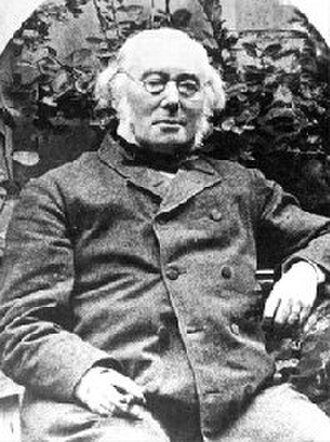
Albrecht Ritschl
1822–1889 · German Protestant theologian
Albrecht Ritschl (Berlin, 1822 – Göttingen, 1889) was a German Protestant theologian who taught systematic theology from 1852. He belonged to the Lutheran tradition of the nineteenth century, and his work marked a turning point in German theology: he sought to give faith its own ground, distinct from scholastic philosophy. His thought remained a key reference for liberal and neo-Protestant theology in the late nineteenth and early twentieth centuries.
His father, Georg Karl Benjamin Ritschl, served as a pastor at St Mary's in Berlin and, from 1827 to 1854, as evangelical bishop of Pomerania. Albrecht studied at Bonn, Halle, Heidelberg and Tübingen. At Halle he came under Hegelian influence through Julius Schaller and Johann Erdmann, and in 1845 he joined the Tübingen school of Ferdinand Baur. His 1846 study of the Gospel of Marcion and the canonical Gospel of Luke reflects that allegiance, but the second edition of his work on the origin of the Old Catholic Church (1857) shows that he had broken away from Baur's method. He taught at Bonn and, from 1864, at Göttingen. There he studied Kant and Schleiermacher closely, and later came under the influence of Hermann Lotze. His main work, The Christian Doctrine of Justification and Reconciliation, appeared between 1870 and 1874 and contains his systematic theology. Between 1882 and 1886 he also published a history of Pietism.
Ritschl held that faith rests not on verifiable historical facts or on pure reasoning but on value judgments, which evaluate things by their bearing on our moral and spiritual welfare. He set this religious knowledge apart from theoretical and disinterested judgments. Jesus' divinity was understood as a revelatory value for the community that acknowledges him as God, and the objective basis of theology was the religious experience of that community. God is love directed toward the Kingdom of God, understood as the moral organisation of humanity, and reconciliation is described as the restoration of the filial relationship with the Father. He criticised Aristotelianism and Hegelianism for their abstraction, though his emphasis on the practical led him to distrust metaphysics, and critics argued that it bordered on subjectivism and agnosticism.
His work provoked strong opposition, yet the Ritschlian school grew rapidly, and many of his disciples held theology chairs in Germany in the late nineteenth and early twentieth centuries. His legacy is twofold: he strengthened German theology's confidence in its own method, and he opened a lasting debate on the relation between religious experience, morality and knowledge.
Key ideas
- Value judgment: faith does not arise from demonstrable facts but from judgments that weigh things by their relevance to our moral and spiritual welfare.
- Believing community: the starting point of theology is the religious experience of the Christian community, not that of the isolated individual.
- Kingdom of God: God is love, and the aim of that love is the moral organisation of humanity into a kingdom.
- Jesus' divinity as revelatory value: Christ's divine status is understood as a predicate that faith attributes to him in his founding and redeeming work.
- Critique of metaphysics: he rejected Hegelianism and Aristotelianism for claiming to encompass life with abstract categories.
Original Filopedia text based on Wikipedia (es) and Wikipedia (en) and Wikidata.