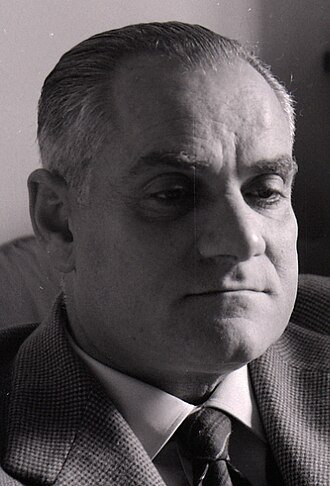
Alberto Moravia
1907–1990 · Italian novelist and journalist
Alberto Pincherle, better known by the pen name Alberto Moravia, was an Italian novelist and journalist born in Rome in 1907 and who died in the same city in 1990. He wrote in Italian through most of the twentieth century, living through Fascism, the war and the postwar years. His fiction returns again and again to the Italian middle class, to sexuality and to the sense of alienation felt by modern individuals, which made him one of the most widely read narrative voices of his country.
He came from a comfortable family: his father, Carlo, was an architect and painter of Venetian origin, and his mother, Teresa Iginia De Marsanich, came from Ancona. At the age of nine he developed tuberculosis of the bone, which kept him in bed for five years, three at home and two in a sanatorium. He never completed regular schooling and educated himself through extensive reading of Shakespeare, Molière, Dostoevsky and Joyce, while learning French and German. Leaving the sanatorium at eighteen, he began the novel Gli indifferenti, which came out in 1929, partly at his own expense. Its portrait of a bourgeois family worn down by apathy brought him rapid fame in Italy.
In the 1930s he wrote for newspapers and magazines, co-founded literary journals with Mario Pannunzio and lectured in the United States. The Fascist regime censored several of his works, including Agostino, which pushed him toward allegorical stories and, at certain points, toward publishing under a pseudonym. In 1941 he married the novelist Elsa Morante. After the armistice of 1943 the couple took refuge in Fondi, and once back in Rome he wrote for the press, especially for the Corriere della Sera, to which he contributed until his death.
His best-known books came after the war, among them The Woman of Rome, Disobedience and The Conformist, the last a critical study of Fascism seen through a man who conforms to power out of fear of standing out. He won the Strega Prize in 1952 for his short stories. His style is spare, realistic and cool, rooted in nineteenth-century narrative, and his recurring themes include desire, money, social hypocrisy and existentialism. He served as president of PEN International from 1959 to 1962.
His legacy is most visible in film, since directors such as Bertolucci, Godard, De Sica and Maselli adapted several of his novels. Moravia was also a steady film critic and a close observer of European politics, and he was nominated for the Nobel Prize in Literature several times without ever receiving it.
Key works
- The Time of Indifference (1929): his first novel and the book that made his name, about a bourgeois family sunk in apathy.
- The Woman of Rome (1947): a portrait of a woman who lives by her body in postwar Rome.
- The Conformist (1951): the story of a man who submits to Fascism to avoid notice.
- Boredom (1960): an uneven relationship between a wealthy young painter and a girl from Rome.
Where to start
Moravia's first novel, written while he was young, follows a middle-class Roman family in decline and the apathy of its members toward corruption and their own lack of will. It is a direct, accessible read that introduces the core themes of his work: alienation, social hypocrisy and the inability to act.
Next: The Conformist. The Conformist takes these themes into the fascist era, following a protagonist desperate to fit into normal life.
Works in Filopedia
- The Time of Indifference 1929
- The Conformist 1951
- Contempt 1954
- Roman Tales 1954
- Boredom 1960
Curiosities
A childhood in bed
At nine he contracted a bone form of tuberculosis that kept him in bed for five years, an experience that shaped his self-taught education.
A visit to Hiroshima
In 1982 he visited Hiroshima and wrote about the effects of the atomic bomb, with articles published in the magazine L'Espresso.
Original Filopedia text based on Wikipedia (es) and Wikipedia (en) and Wikidata.