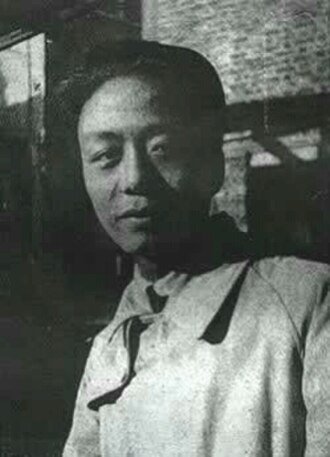
Ai Qing (1910–1996) was one of the most important Chinese poets of the twentieth century. Born in Zhejiang province in eastern China, he wrote in Chinese, and his career spans the Republican era, the war with Japan, and the first decades of Communist China. He matters because he combined a sensibility shaped by European poetry with a close attention to the suffering of ordinary Chinese people.
As a young man he trained at the Hangzhou Xihu Art School and then spent several years in Paris from 1929, where he absorbed the painting of Renoir and Van Gogh and the philosophy of Kant and Hegel. The Belgian poet Émile Verhaeren, however, left the deepest mark on his writing. Back in Shanghai in 1932 he joined leftist literary circles, was arrested for opposing the Kuomintang, and spent three years in prison, where he translated Verhaeren and wrote his first book, Dayanhe, My Nanny.
After the Second Sino-Japanese War began in 1937, he wrote "Snow Falls on China's Land" on reaching Wuhan, a poem in which war and landscape merge. He then lived in Guilin, Chongqing and Yan'an, where he joined the Communist Party. His work of these years blends personal lyricism with a wish to speak to the masses. After 1949 he sat on cultural committees and edited literary journals, but his views on the independence of the creative writer drew criticism in 1956. In 1957, after defending Ding Ling during the Anti-Rightist Campaign, he was labelled a rightist and sent to farms in the northeast, and in 1959 to Xinjiang, where he endured very harsh conditions during the Cultural Revolution.
He was not allowed to publish his works until he was reinstated in 1979. He returned to France in 1980, and in 1985 President François Mitterrand made him a Commander of the Order of Arts and Letters. His legacy is twofold: he turned the Chinese experience of the twentieth century into lyric poetry, and he is the father of the artist Ai Weiwei, an internationally known figure in art and dissent.
Key works
- Dayanhe, My Nanny (1933): his first book, written while he was imprisoned in Shanghai.
- Snow Falls on China's Land (1937): a poem written on arriving in Wuhan during the war with Japan.
- Song of Returning (1979): a work he could not publish for years, reflecting his return after rehabilitation.
- Ode to Light (1979): a long poem published after his rehabilitation, affirming faith in light against the darkness of the years of persecution.
Curiosities
A shared surname
According to tradition, while writing his surname in prison he crossed out the rest of the character with an X, in protest against Chiang Kai-shek. The resulting character 艾 (ài) became the basis of his pen name.
Cleaning latrines
During the Cultural Revolution, according to his son Ai Weiwei's account, he spent five years cleaning the communal toilets of his village, and lost the sight of one eye due to malnutrition.
Original Filopedia text based on Wikipedia (es) and Wikipedia (en) and Wikidata.