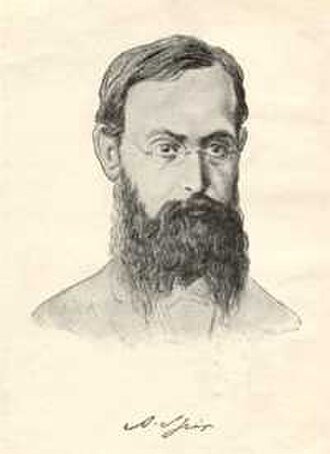
African Spir
1837–1890 · Russian-born critical philosopher in the Kantian tradition
Afrikan Spir (1837–1890) was a philosopher born in the Russian Empire to a family of German and Greek descent, who wrote mainly in German. He belongs to the critical, Kantian current of the nineteenth century. His significance lies in the influence he had on Nietzsche, William James and Tolstoy, although he was barely recognised during his lifetime.
Born on his family's estate in the Russian Empire, he studied in Odessa and later in Leipzig, where he attended the lectures of Drobisch. He served in the navy and took part in the Crimean War. After inheriting his father's lands, he freed his serfs. He settled in Germany, married in Stuttgart and eventually made his home in Switzerland, where he died in Geneva in 1890.
His main work, Thought and Reality (1873), holds that the principle of identity, A is A, is the fundamental law of knowledge and the key to what is real. Only what is identical to itself is truly real, while the empirical world, in constant change, is illusory. On this basis he built a shared foundation for religion, morality and philosophy, and he argued for a fairer distribution of wealth without endorsing collectivism.
Key ideas
- Principle of identity: the fundamental law of knowledge, according to which whatever is, is identical to itself.
- Reality versus appearance: what is truly real is what remains identical; the ever-changing empirical world is illusory.
- Moral dualism: the gap between the empirical and the moral nature of human beings is the basis of moral judgment.
- Critical philosophy: philosophy should investigate immediate knowledge and expose the errors of empiricism.
Curiosities
Same bastion as Tolstoy
During the siege of Sevastopol, Spir defended the same bastion as Leo Tolstoy.
An attentive reader
Nietzsche owned the second edition of Thought and Reality and called Spir "the logician I value".
Teachers and influences
Influenced
- Leo Tolstoy 1828–1910
- Friedrich Nietzsche 1844–1900
Original Filopedia text based on Wikipedia (en) and Wikidata.