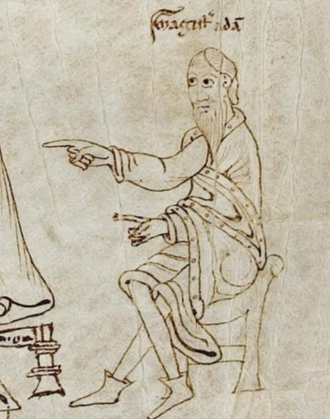
Adam of Balsham
1100–1181 · Anglo-Norman logician and churchman, master of the Petit-Pont in Paris
Adam of Balsham, also known as Adam du Petit-Pont or Adam Parvipontanus, was a logician and churchman of Anglo-Norman origin who taught in Paris around the middle of the twelfth century. He is regarded as the founder of the Parvipontani, a school of logic that rivalled Abelard's school in the early phase of scholasticism.
He was born around 1100 in Balsham, near Cambridge, probably into a family of Norman or French descent. He studied with Peter Lombard at the cathedral school of Notre-Dame in Paris, then taught the trivium at a school beside the Petit-Pont, the small bridge linking the Île de la Cité with the Left Bank of the Seine, which gave his school its name. He was ordained a canon in 1145 and taught for about twelve more years. Around 1159 he seems to have returned to England, where he died before 1169. His pupils included John of Salisbury and William of Tyre.
His main work was the Ars disserendi, a widely circulated commentary on Aristotle's Prior Analytics focused on dialectic. In it he examined the liar paradox in depth, a concern that was largely theological, since logical reasoning had to avoid contradictions in theology. He is also credited with recognising that an infinite set may contain a subset equivalent to itself, an idea later taken up by Dedekind, Cantor and Peirce.
His influence reached later medieval logic, and his treatise remained a standard reference on the subject until Thomas Bradwardine took up paradoxes.
Key ideas
- The liar paradox: he examined this paradox in depth, one of the earliest medieval discussions of it.
- Logic in the service of theology: he saw rigorous logic as necessary to avoid contradictory theological arguments.
- Infinite sets: he recognised that an infinite set could be a subset of itself.
- The term enuntiabile: he is said to have been among the first to use it in the sense of dictum, the content of a proposition.
Teachers and influences
Pupils
- John of Salisbury 1110–1180
Original Filopedia text based on Wikipedia (es) and Wikipedia (en) and Wikidata.