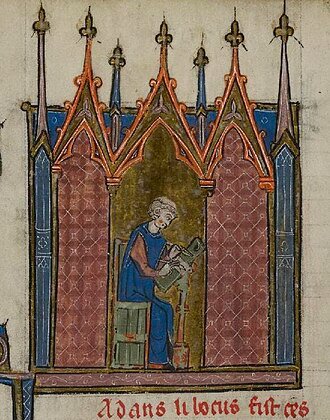
Adam de la Halle
1237–1288 · trouvère and French poet-composer
Adam de la Halle was a trouvère, a poet-composer who wrote in the langue d'oïl, born in Arras probably around 1237 and dead by about 1288, possibly in Naples. He belonged to the third generation of trouvères, active between 1250 and 1300, and he matters because he was among the first to take music and verse beyond the church and into secular theatre in France.
His father, Henri de la Halle, was a well-known citizen of Arras. Adam studied grammar, theology and music at the Cistercian abbey of Vaucelles, near Cambrai. He was meant for the Church but gave up that path and married a woman named Marie, who appears in many of his songs. He and his father were drawn into the civil quarrels of Arras and for a time sought refuge in Douai. He later served Robert II, Count of Artois, and then Charles of Anjou, brother of Louis IX, whose entourage took him through Egypt, Syria, Palestine and Italy. His last years were spent at Charles's court in Naples.
His output includes chansons, jeux-partis (poetic debates), rondeaux and motets, mixing inherited trouvère forms with polyphonic pieces in the older liturgical manner. This double position has led critics to see him as both conservative and innovative. His best-known work, Le jeu de Robin et Marion, composed around 1275, is a pastoral in which dialogue alternates with popular refrains and Marion resists a knight to stay faithful to the shepherd Robin. Its folk-like melodies sound more spontaneous than the more elaborate music of his motets. Together with Le jeu de la feuillée, a satire in which he portrays himself, his father and the townspeople of Arras, it is regarded as a forerunner of comic opera.
His legacy is twofold: he closed the trouvère tradition, and he is recognised as a pioneer of secular musical drama in France. Interest in him revived in 1896, when a company from the Paris Opéra-Comique performed Julien Tiersot's adaptation of his play at Arras, as a festival tribute.
Key works
- Le jeu de Robin et Marion (around 1275): a pastoral play with dialogue and popular refrains, considered the earliest surviving French secular play with music.
- Le jeu de la feuillée (around 1276): a satire in which the author appears as himself, alongside his father and the citizens of Arras.
- Chanson du Roi de Sicile: an unfinished epic in honour of Charles of Anjou, begun around 1282.
- Les vers d'amour: love songs in the trouvère tradition, within his wider repertoire of chansons.
Works in Filopedia
Curiosities
A nickname with doubts
His nicknames, such as 'the Hunchback of Arras', were probably a family surname; Adam himself points out that he was not hunchbacked.
A tribute in 1896
A company from the Paris Opéra-Comique performed an adaptation of *Le jeu de Robin et Marion* in Arras during a festival held in his honour.
Original Filopedia text based on Wikipedia (es) and Wikipedia (en) and Wikidata.