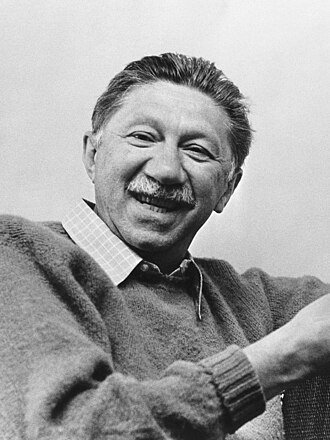
Abraham Maslow
1908–1970 · American psychologist, co-founder of humanistic psychology
Early Life and Family
Abraham Harold Maslow was born on April 1, 1908, in Brooklyn, New York, the oldest of seven children. His parents were first-generation Jewish immigrants from Kyiv, then part of the Russian Empire, who had fled Tsarist persecution in the early twentieth century. The family settled in a poor, working-class, multiethnic neighborhood of New York City. His parents had little money and no particular intellectual interests, although they valued education.
Maslow later recalled a lonely and unhappy childhood. He had encounters with antisemitic gangs that chased him and threw stones, and he had few friends apart from his cousin Will. He spent his time in libraries and among books, where his love of reading and learning took root. He also developed a deep aversion to his mother, whom he described as selfish, prejudiced and unloving.
School and First Steps at University
He attended Boys High School, one of the best secondary schools in Brooklyn, where he held office in several academic clubs, edited the Latin magazine and, for a year, the school's physics paper. As a boy he believed physical strength was the defining mark of true manhood and lifted weights in the hope of becoming more muscular, an ambition he never achieved.
After high school he entered the City College of New York. In 1926 he began evening law classes alongside his undergraduate work, but he disliked them and quickly withdrew. In 1927 he moved to Cornell University, but left after a single semester because of poor grades and high costs. He later graduated from City College and chose to study psychology.
Training at Wisconsin
In 1928, before completing his studies, he married his first cousin Bertha, who was still at high school and whom he had known in Brooklyn for years. He then went to the University of Wisconsin for graduate work, where psychology was decidedly experimental and behaviorist. There his principal mentor was Harry Harlow, and he pursued research on primate dominance behavior and sexuality.
His early exposure to behaviorism left him with a strongly positivist outlook. On the advice of Professor Hulsey Cason he wrote a master's thesis on learning, retention and reproduction of verbal material. Maslow thought the work embarrassingly trivial and even removed it from the psychology library, but Cason admired it enough to urge its publication, and two articles based on it appeared in 1934. He earned his bachelor's degree in 1930, his master's in 1931 and his doctorate in 1934, all in psychology at Wisconsin.
Academic Career and New Influences
After graduating he returned to New York and worked with Edward Thorndike at Columbia University, where he began investigating human sexuality and found another mentor in Alfred Adler, one of Sigmund Freud's early colleagues. From 1937 to 1951 he taught at Brooklyn College, where he came into contact with European émigrés such as Erich Fromm and Karen Horney, as well as Gestalt and Freudian psychologists. He also knew the anthropologist Ruth Benedict and the Gestalt psychologist Max Wertheimer, whom he admired both professionally and personally. Taking notes on their lives and conduct became the foundation of his lifelong work on mental health and human potential.
When the United States entered the Second World War in 1941, Maslow, already in his thirties and the father of two children, was ineligible for military service. The war nonetheless stirred in him a vision of peace and inspired his groundbreaking studies of self-actualization. After the war he began to question how psychologists reached their conclusions and, without wholly rejecting them, developed his own ideas about the human mind, which he called humanistic psychology.
Brandeis and the Development of His Theory
In 1951 he moved to Boston to head the psychology department at Brandeis University, a post he held until 1969. There he encountered Kurt Goldstein, who introduced him to the concept of self-actualization, and he developed his own theoretical project. He extended the subject by borrowing ideas from other psychologists and adding his own, including the concepts of a hierarchy of needs, metaneeds, metamotivation, self-actualizing persons and peak experiences. His pyramid of needs, first presented in 1943, held that physiological needs are the only ones present from birth and that the others emerge once the more basic ones are met. Only unmet needs, he argued, alter behavior; a satisfied need produces no effect of its own.
He arranged the hierarchy in five levels: physiological needs at the base, then safety and protection, love and belonging, and esteem, which combines self-esteem with the esteem others give us, with self-actualization at the summit. To describe self-actualizing people he studied healthy individuals rather than the seriously troubled, and he drew on the writings of Albert Einstein as an example. He found that his subjects shared traits such as a grounding in reality, a problem-centered approach to life, comfort in solitude and a few deep personal relationships rather than many superficial ones. He held that such people have peak experiences more often than others, and he came to believe that psychedelic drugs such as LSD and psilocybin could induce them in the right people under the right conditions.
Legacy and Final Years
Maslow became the leading figure of the humanist school that emerged in the 1950s and 1960s, which he called the "third force", beyond psychoanalysis and behaviorism. Where psychology had concerned itself largely with the abnormal and the ill, he urged inquiry into what constitutes positive mental health. The movement gave rise to several therapies, the most famous being Carl Rogers's client-centered therapy. Critics have faulted humanistic psychology for its weak empirical validation and its limited usefulness in treating severe disorders. In 1967 the American Humanist Association named him Humanist of the Year.
That same year he suffered a serious heart attack and became convinced his time was limited. Semi-retired from teaching, he turned to an ambitious theoretical project he never finished: developing a philosophy and an ethics consistent with the hypotheses of humanistic psychology. He died of a heart attack on June 8, 1970, in Menlo Park, California, while jogging, at the age of sixty-two. He is buried at Mount Auburn Cemetery. A 2002 survey published in the Review of General Psychology ranked him the tenth most cited psychologist of the twentieth century.
Key ideas
- Hierarchy of needs: human needs are arranged in levels, from physiological needs up to self-actualization, and higher ones emerge once basic ones are met.
- Unmet needs: a satisfied need no longer shapes behavior; only unmet needs guide it.
- Third force: humanistic psychology was offered as an alternative to behaviorism and psychoanalysis, focused on people's positive potential.
- Self-actualization: each person's drive to fully develop their abilities.
- Peak experiences: moments of harmony with oneself and the environment, more frequent in self-actualized people.
Curiosities
A thesis he tried to hide
Ashamed of his master's thesis, he removed it from the psychology library and tore out its catalogue entry. His adviser, Hulsey Cason, thought it worth publishing, and it appeared as two articles in 1934.
A movement without a leader
In 1963 he turned down the presidency of the Association for Humanistic Psychology, believing the movement should develop intellectually without a leader.
Teachers and influences
Teachers
- Alfred Adler 1870–1937
Original Filopedia text based on Wikipedia (es) and Wikipedia (en) and Wikidata.